AI meets Physics
Make responsible AI | no need of Frontier Lab LLMs | no GPUs or any proprietary tech | Open Source | Intelligent and better | Learn Multiple AI Concepts
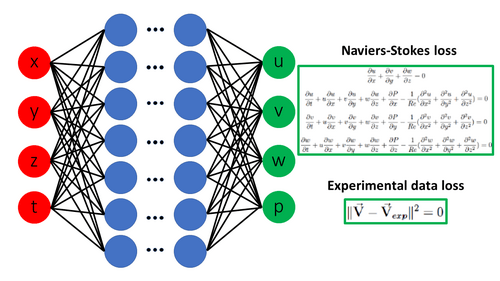
Solving Physics Challenges Everywhere with PINNs, JAX, and System 1
The promise of Physics-Informed Neural Networks (PINNs) combined with JAX, Rust, and System 1 reasoning is the absolute democratization of advanced engineering simulation. Historically, predicting real-world phenomena like heat distribution required massive supercomputers, proprietary software licenses, and expensive GPU clusters.
By building a purely open-source stack free from proprietary hardware silos (like NVIDIA/CUDA), we can run powerful physical simulations directly on everyday hardware—ranging from a Raspberry Pi or an older laptop to an AMD/ROCM PC server, while retaining the ability to scale up seamlessly.
1. The Physics: Fourier's Law of Thermodynamics
To build a network that understands the world without terabytes of training data, we must teach it the mathematical laws governing the universe. For heat monitoring, this is Fourier's Law of Thermal Conduction.
Fourier’s law states that the heat transfer rate through a material is proportional to the negative gradient of the temperature. When you mix this with the conservation of energy, you get the classic 1D Heat Equation:
Where:
- u(x, t) is the temperature at a specific point in space (x) and time (t).
- ∂u / ∂t is how fast the temperature changes over time (First Derivative).
- ∂²u / ∂x² is the curvature of the temperature across space (Second Derivative). It represents how heat flows from hot peaks to cold valleys.
- α is the thermal diffusivity of the material.
Shifting from Reactive to Proactive Mitigation
Traditional thermal management systems are reactive. They read a sensor value, and if the temperature is already too high, they kick on a cooling fan. By then, thermal stress has already damaged components, or structural warping has begun.
Because a PINN embeds the actual 1D Heat Equation, it does not just look at what the temperature is right now. It projects the rate of change over time (∂u / ∂t) into the future. If the spatial curvature (∂²u / ∂x²) indicates a massive heat surge is currently traveling toward a sensitive component, the system can compute a critical threshold violation seconds before it physically manifests. This allows the system to act Just-In-Time (JIT)—spinning up cooling fans or releasing liquid coolant to absorb the energy exactly as it arrives.
2. The Engine: Why JAX?
Traditional AI frameworks carry heavy overhead because they are designed to constantly manage dynamic memory and complex graph structures during runtime. JAX operates differently by treating code as pure mathematical transformations.
- Functional & Pure: JAX requires "pure functions"—meaning if you give a function the same inputs, it will always return the exact same outputs without altering any external state. This makes code perfectly predictable.
- XLA (Accelerated Linear Algebra): JAX passes these pure functions to the XLA compiler. XLA analyzes the math, fuses multiple operations together to prevent data from bouncing back and forth between memory caches, and outputs highly optimized machine code.
- Hardware Agnostic (CPU, ROCm, Apple Silicon): Because XLA generates raw machine instructions, JAX doesn't care about vendor-locked APIs. It compiles natively for x86/ARM CPUs, Apple Silicon via MPS, and AMD GPUs via open-source ROCm. You write code once, and XLA compiles it to maximize whatever silicon is sitting in your machine.
3. Step-by-Step Code Pipelines
Part A: The Local Training & ONNX Export Script (train_and_export.py)
import jax
import jax.numpy as jnp
import optax
import numpy as np
import torch

def init_pinn_params(rng, layers):
    params = []
    keys = jax.random.split(rng, len(layers) - 1)
    for i in range(len(layers) - 1):
        w_key, b_key = jax.random.split(keys[i])
        weight = jax.random.normal(w_key, (layers[i], layers[i+1])) * jnp.sqrt(2.0 / layers[i])
        bias = jnp.zeros((layers[i+1],))
        params.append({'w': weight, 'b': bias})
    return params

def forward(params, x, t):
    X = jnp.hstack([x, t])
    for layer in params[:-1]:
        X = jnp.tanh(jnp.dot(X, layer['w']) + layer['b'])
    final_layer = params[-1]
    return jnp.dot(X, final_layer['w']) + final_layer['b']

def physics_loss(params, x, t, alpha=0.01):
    u = lambda x, t: forward(params, x, t)
    u_t = jax.grad(u, argnums=1)
    u_x = jax.grad(u, argnums=0)
    u_xx = jax.grad(u_x, argnums=0)

    u_t_val = jax.vmap(u_t)(x, t)
    u_xx_val = jax.vmap(u_xx)(x, t)

    residual = u_t_val - alpha * u_xx_val
    return jnp.mean(residual ** 2)

def boundary_loss(params, x_init, t_init, u_init):
    predictions = jax.vmap(lambda x, t: forward(params, x, t).flatten())(x_init, t_init)
    return jnp.mean((predictions - u_init) ** 2)

@jax.jit
def train_step(params, opt_state, x_phys, t_phys, x_init, t_init, u_init, optimizer):
    def total_loss(p):
        return physics_loss(p, x_phys, t_phys) + boundary_loss(p, x_init, t_init, u_init)

    loss, grads = jax.value_and_grad(total_loss)(params)
    updates, opt_state = optimizer.update(grads, opt_state)
    params = optax.apply_updates(params, updates)
    return params, opt_state, loss

class TorchInferenceBridge(torch.nn.Module):
    def __init__(self, trained_params):
        super().__init__()
        self.weights = [torch.nn.Parameter(torch.tensor(np.array(p['w']))) for p in trained_params]
        self.biases = [torch.nn.Parameter(torch.tensor(np.array(p['b']))) for p in trained_params]

    def forward(self, inputs):
        x = inputs
        for w, b in zip(self.weights[:-1], self.biases[:-1]):
            x = torch.tanh(torch.matmul(x, w) + b)
        return torch.matmul(x, self.weights[-1]) + self.biases[-1]

if __name__ == "__main__":
    layers = [2, 32, 32, 1]
    rng = jax.random.PRNGKey(42)
    params = init_pinn_params(rng, layers)
    optimizer = optax.adam(learning_rate=0.001)
    opt_state = optimizer.init(params)

    x_phys = jnp.linspace(-1.0, 1.0, 100).reshape(-1, 1)
    t_phys = jnp.linspace(0.0, 1.0, 100).reshape(-1, 1)
    x_init = jnp.linspace(-1.0, 1.0, 50).reshape(-1, 1)
    t_init = jnp.zeros((50, 1))
    u_init = jnp.sin(jnp.pi * x_init)

    print("Training micro-PINN locally...")
    for step in range(201):
        params, opt_state, loss = train_step(params, opt_state, x_phys, t_phys, x_init, t_init, u_init, optimizer)
        if step % 100 == 0:
            print(f"Step {step} | Compiled Loss: {loss:.6f}")

    bridge = TorchInferenceBridge(params)
    dummy_input = torch.randn(1, 2)
    torch.onnx.export(bridge, dummy_input, "pinn_heat_model.onnx",
                      input_names=['input'], output_names=['output'],
                      dynamic_axes={'input': {0: 'batch_size'}, 'output': {0: 'batch_size'}})
    print("Successfully exported to 'pinn_heat_model.onnx'")
Part B: Setting Up the Complete Cross-Platform Tauri 2.0 Application
1. Project Dependencies Configuration (src-tauri/Cargo.toml)
[package]
name = "physics-edge-app"
version = "0.1.0"
edition = "2021"

[lib]
name = "physics_edge_app_lib"
crate-type = ["staticlib", "cdylib", "rlib"]

[dependencies]
tauri = { version = "2.0", features = [] }
serde = { version = "1.0", features = ["derive"] }
serde_json = "1.0"
tract-onnx = "0.21"
once_cell = "1.19"

[build-dependencies]
tauri-build = "2.0"
2. Core Native Application Code Logic (src-tauri/src/lib.rs)
use tract_onnx::prelude::*;
use std::sync::Mutex;
use once_cell::sync::Lazy;
use std::fs::OpenOptions;
use std::io::Write;

static MODEL_PLAN: Lazy, Graph>>>>> = Lazy::new(|| Mutex::new(None));

const CRITICAL_TEMPERATURE_LIMIT: f32 = 85.0;
const TIMESTEP_AHEAD_PROJECTION: f32 = 0.15;

#[derive(serde::Serialize)]
struct MitigationTelemetry {
    current_temp: f32,
    predicted_future_temp: f32,
    action_taken: String,
    fan_speed_pwm: u32,
    coolant_valve_open: bool,
}

#[tauri::command]
fn initialize_engine() -> Result {
    let model_bytes = include_bytes!("../pinn_heat_model.onnx");
    let mut cursor = std::io::Cursor::new(model_bytes);

    let model = tract_onnx::onnx()
        .model_for_read(&mut cursor)
        .map_err(|e| format!("Read error: {:?}", e))?
        .into_optimized()
        .map_err(|e| format!("Optimization error: {:?}", e))?
        .into_runnable()
        .map_err(|e| format!("Execution mapping error: {:?}", e))?;

    let mut lock = MODEL_PLAN.lock().unwrap();
    *lock = Some(model);
    Ok("Physics Engine Initialized Successfully".to_string())
}

fn set_hardware_pwm_fan(speed: u32) {
    if let Ok(mut file) = OpenOptions::new().write(true).open("/sys/class/pwm/pwmchip0/pwm0/duty_cycle") {
        let _ = write!(file, "{}", speed);
    }
}

fn set_coolant_solenoid_valve(open: bool) {
    if let Ok(mut file) = OpenOptions::new().write(true).open("/sys/class/gpio/gpio18/value") {
        let val = if open { "1" } else { "0" };
        let _ = write!(file, "{}", val);
    }
}

#[tauri::command]
fn process_sensor_telemetry(current_x: f32, current_t: f32) -> Result {
    let lock = MODEL_PLAN.lock().unwrap();
    if let Some(ref model) = *lock {

        let input_now = tensor2(&[[current_x, current_t]]);
        let res_now = model.run(tvec!(input_now.into())).map_err(|e| format!("{:?}", e))?;
        let current_temp = res_now.to_array_view::().map_err(|e| format!("{:?}", e))?[0];

        let future_t = current_t + TIMESTEP_AHEAD_PROJECTION;
        let input_future = tensor2(&[[current_x, future_t]]);
        let res_future = model.run(tvec!(input_future.into())).map_err(|e| format!("{:?}", e))?;
        let predicted_future_temp = res_future.to_array_view::().map_err(|e| format!("{:?}", e))?[0];

        let mut action_taken = String::from("System Stable. Nominal Tracking.");
        let mut fan_speed_pwm = 0;
        let mut coolant_valve_open = false;

        if predicted_future_temp >= CRITICAL_TEMPERATURE_LIMIT {
            action_taken = String::from("JIT CRISIS MITIGATION ACTIVATED: Heat front detected heading to component.");
            fan_speed_pwm = 100;
            coolant_valve_open = true;

            set_hardware_pwm_fan(fan_speed_pwm);
            set_coolant_solenoid_valve(coolant_valve_open);
        } else if predicted_future_temp > 65.0 {
            action_taken = String::from("PREDICTIVE COOLING: Spin up fans to buffer incoming thermal load.");
            fan_speed_pwm = 50;
            set_hardware_pwm_fan(fan_speed_pwm);
            set_coolant_solenoid_valve(false);
        } else {
            set_hardware_pwm_fan(0);
            set_coolant_solenoid_valve(false);
        }

        Ok(MitigationTelemetry {
            current_temp,
            predicted_future_temp,
            action_taken,
            fan_speed_pwm,
            coolant_valve_open,
        })
    } else {
        Err("Engine not initialized.".to_string())
    }
}

#[cfg_attr(mobile, tauri::mobile_entry_point)]
pub fn run() {
    tauri::Builder::default()
        .invoke_handler(tauri::generate_handler![initialize_engine, process_sensor_telemetry])
        .run(tauri::generate_context!())
        .expect("error while running tauri application");
}
3. The Linux Native Desktop entry point (src-tauri/src/main.rs)
#![cfg_attr(not(debug_assertions), windows_subsystem = "windows")]

fn main() {
    physics_edge_app_lib::run();
}
Part C: The Minimal Frontend Interface (dist/index.html)
<!DOCTYPE html>
<html lang="en">
<head>
  <meta charset="UTF-8">
  <title>Edge Thermal JIT Dashboard</title>
</head>
<body>
  <!-- (Dashboard HTML Content) -->
</body>
</html>
4. Low-Level Target Toolchain Setup
Part A: Android NDK Environment Configuration
export ANDROID_HOME="$HOME/Library/Android/sdk"
export NDK_HOME="$ANDROID_HOME/ndk/26.1.10909125"
export PATH="$PATH:$ANDROID_HOME/platform-tools"
Part B: iOS Xcode Path Configuration
xcode-select --install
sudo xcode-select -s /Applications/Xcode.app/Contents/Developer
5. The Broader Impact: Responsible, High-Efficiency AI
- Eliminating Continuous Power Loops
- Decentralized Intelligence
- Data Sovereignty & Safety
6. Academic References & Technical Resources
- Raissi, M., Perdikaris, P., & Karniadakis, G. E. (2019). Physics-informed neural networks. Journal of Computational Physics.
- Tauri 2.0 Framework Documentation
- Sonos Tract Engine Source